

1 Finance ships 3x faster and breaks less, with Claude and Atrina

Industry: Financial services (India) · Product: Claude Code, Claude for Teams/Enterprise · Partner: Atrina · Location: Asia Pacific
PlanMyTax.ai, live in 1.5 months instead of an estimated 6, roughly 4x faster than the original timeline
3x faster development cycles across the wider engineering organisation, from three months down to about one
70% fewer rollbacks and 50%+ fewer production incidents, even as release speed went up
QA pass rate up 80%, alongside 60% faster pull request turnaround
From a monthly pilot to a signed annual contract, scaling to 75 developers before 1 Finance committed a core team of 30 to a long-term plan, trial spend converting to locked-in investment
1 Finance is a SEBI-registered investment advisor that builds personalised financial plans for individuals across India, covering income and expense planning, investments, insurance, tax, loans, and retirement, all without commissions. Behind that advisory business is an engineering team that ships product on a continuous basis. To scale Claude across that team without the usual pilot-then-plateau pattern, 1 Finance brought in Atrina to run its Claude adoption program as an external AI Center of Excellence.
With Claude, 1 Finance:
- Took PlanMyTax.ai (a full-stack AI-powered tax filing platform) from concept to live launch in 1.5 months, against an original estimate of 6
- Cut development cycle time from roughly three months to about one across the wider engineering organisation
- Reduced rollbacks by 40% and production incidents by 20%, while shipping faster, not despite it
- Increased QA pass rate by 40% and sped up pull request turnaround by approximately 60%
- Rebuilt its product development lifecycle as PDLC 2.0, pairing Claude with human judgment differently at each stage of the process
- Scaled Claude Code from a 40-developer pilot to 75 developers, then to a committed annual core of 30
- Stood up an external AI Center of Excellence with Atrina, covering skills deployment, usage governance, and adoption tracking
The challenge
Financial planning is 1 Finance’s core business, but it is far from the only thing its engineering team ships. Alongside it, the company runs the 1 Finance app, the 1 Finance website, India-focused macroeconomic data and insights platform (indiamacroindicators.co.in), Crypto research and analytics platform (indiacryptoresearch.co.in) , and a Peer-to-Peer lending platform (1financep2p.com), each with its own roadmap and release cadence.
EOS (Enterprise OS), the backbone of 1 Finance’s advisory business, centralises the history of every client relationship: what was recommended, what was assigned, and where the client stands today. Alongside EOS, the company also had PlanMyTax.ai (a full-stack, AI-powered tax-filing platform) in active development, built to take a taxpayer from a tax question through to a filed, e-verified return.
That is the harder version of the scaling problem: it is not enough to get one team building faster. Multiple product lines, including the ones the advisory business itself runs on, have to ship at speed at the same time, without quality slipping on any one of them, and new products sometimes need to go from concept to live launch on a compressed timeline.
Under 1 Finance’s original PDLC, every stage of that lifecycle, from ideation through release, ran on human effort alone. That model does not bend easily when the number of products in flight goes up. Adding people scales cost roughly in a straight line; it does not scale speed the way a growing product portfolio demands. Leadership’s real question was not whether Claude could help developers work faster in isolation. It was whether an AI-augmented lifecycle could hold delivery speed and quality together as 1 Finance ran more products at once, not fewer.
The solution
A roadmap before a rollout
Before a single developer touched Claude Code, Atrina led a structured AI Strategy and Roadmap engagement across 1 Finance’s engineering, advisory, and operations functions, identifying where Claude would create the most impact and in what order to introduce it. That engagement produced PDLC 2.0: a redesign of 1 Finance’s product development lifecycle around Claude and human judgment working together, rather than Claude added on top of an unchanged process.
“Our focus was never just to roll out Claude licenses, it was to redesign how teams build with AI.
By combining Claude with the right workflows, governance, and human judgment, 1 Finance turned adoption into measurable engineering impact.” – Amol Bhanushali
Pairing Claude and human judgment stage by stage
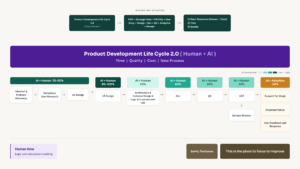
PDLC 2.0 does not apply Claude evenly across the development lifecycle. Atrina and 1 Finance mapped AI and human contribution at each stage of the process:
- Ideation, problem discovery, and secondary user research: 70 to 90% AI and human collaboration
- UX design: 70 to 90%
- UI design: 80 to 100%
- Architecture, technical design, and in-person user conversations: around 20%, where 1 Finance’s engineers still lead on logic and calculation building
- Development: around 60%
- QA: around 30%
- UAT and release: around 30%
- Post-launch support, implementation, and user feedback: around 30%
Keeping architecture and technical design human-led was a deliberate choice, not a gap Atrina intends to close. 1 Finance’s products run on financial calculation logic, and errors there carry a different cost than a slow ideation session. Concentrating human judgment at the stage where correctness matters most is what let the rest of the lifecycle move faster without transferring that risk onto the products themselves. QA and UAT are where Atrina and 1 Finance have identified the most room to grow next.
What this looked like on a full product: PlanMyTax.ai
This tax-filing platform is the clearest example of what PDLC 2.0 makes possible, because it wasn’t a single feature. It was a full product, built and taken live in 1.5 months against an original estimate of 6.
The platform is full-stack and AI-powered, built for Indian income tax filing, and it centres on two core flows:
- An AI tax advisor, built on a streaming chat interface, that answers personalised tax questions, parses a user’s Form 16 through vision AI, and generates a tax report with a regime comparison in seconds
- An ITR filing wizard that takes a salaried or self-employed taxpayer from a standing start to a signed, e-verified ITR-1 or ITR-4 submission, entirely in-browser, with no CA involved
Around those two flows, the platform also ships:
- Standalone tax calculators for HRA, NPS, gratuity, IFHP, crypto, and regime comparison
- A B2B white-label API that lets fintechs and NBFCs embed the filing journey under their own brand
- An admin portal for operations, CA assignment, and partner management
- The product is also expected to reach meaningful scale quickly, with 25,000 ITR filings projected between July and August.
Building all of that, the AI advisor, the filing wizard, the calculators, the white-label API, and the admin portal, inside 1.5 months is the kind of scope that would normally demand a much longer build cycle. 1 Finance’s own estimate, based on the scope and complexity involved, put it at around 6 months without Claude in the workflow. PDLC 2.0 is what closed that gap: Claude carrying the load on ideation, UX, UI, and a majority share of development, while 1 Finance’s engineers stayed in control of the architecture, the tax logic, and the calculation accuracy a product like this cannot afford to get wrong.
Three phases, each earning the next
Atrina scaled Claude Code deliberately rather than in one move.
Phase 1: Pilot, 40+ developers. A controlled rollout on a monthly plan, focused on onboarding, training, and identifying which workflows genuinely benefited from Claude Code.
Phase 2: Scale-up, 75 developers. Strong adoption and developer feedback from Phase 1 earned the expansion. Atrina ran additional enablement sessions and rebuilt its guidance materials around what developers were actually asking for.
Phase 3: Annual commitment, 30 core users. Once Claude Code had proven its value in production, 1 Finance moved from trial adoption to a long-term investment: an annual plan for a committed core group of users, with Atrina continuing to support adoption, refine skills, and expand use cases.
The outcome
Speed and quality moved together, which was the actual test:
- Development cycle time: roughly three months down to about one
- Pull request turnaround: about 60% faster
- Rollbacks: down 40%
- Production incidents: down 20%
- QA pass rate: up 40%
Faster releases did not come at the cost of stability across 1 Finance’s product lines. If anything, the two improved together, and that did not happen by giving developers access to Claude Code and leaving them to figure it out. Three things moved in parallel to get there:
A redesigned lifecycle, not a bolt-on. PDLC 2.0 decided, stage by stage, where Claude carries the work and where 1 Finance’s engineers stay in the loop, most visibly by keeping architecture and technical design human-led. The lifecycle changed; Claude was fitted into it deliberately, not dropped on top of the old one.
Skills built once, used everywhere. Atrina deployed Claude skills organisation-wide, so teams working across the 1 Finance app, EOS, the tax-filing platform, and the other product lines weren’t each rebuilding the same workflows from scratch. A pattern solved on one product became reusable on the next, which is part of why the tax-filing platform could move as fast as it did despite being a new, standalone build.
Developers trained to use the tool well, not just given a license. Dedicated sessions on how to prompt Claude effectively and use Claude Code in day-to-day work meant the difference between a developer who knows how to frame a task and one who doesn’t. That gap in skill, not just in access, is what shows up in the rollback, incident, and QA numbers.
Those three together, not access on its own, are why the numbers moved, and why a monthly pilot became an annual commitment: a program that ships faster and breaks less is the kind of result that justifies budget, not just attention.
Atrina continues to run 1 Finance’s Claude program as an ongoing Center of Excellence: deploying skills across the organisation, tracking usage, and iterating on PDLC 2.0 based on real developer feedback, with QA and UAT next in line for improvement.
“Claude helped us move faster, but the real value came from applying it with discipline across the product lifecycle.
With Atrina’s support, we could improve delivery speed without losing control over quality, architecture, or business-critical logic.”- Nikhil Bhosle
If you’re building a Claude Center of Excellence for your own organisation, talk to Atrina about what a structured, phased adoption program looks like in practice.
